If you talk to someone in Dubai for long enough, the topic of discussion will eventually turn to traffic.
The good thing is that Dubai transport bosses know the extent of the problem and have come up with a range of solutions which somehow tow that line between futuristic sci-fi yet sensible and practical.
Dubai’s traffic problems require outside-the-box solutions in addition to standard road improvements and additional metro stations.
As the city’s population continues to grow, Dubai transport bosses are looking to the skies, sea and (with the help of Elon Musk) underground to fix the ongoing traffic problem.
Elon Musk announced plans for the Dubai Loop at the World Governments Summit 2025 in Dubai.
Exact details for how it’ll work have not yet been revealed although a “Loop’ system is currently active in Las Vegas which should give us an idea of what to expect. The Dubai project will initially be 17km long, have 11 stations and the capacity for up to 20,000 passengers per hour. After the initial phase, it aims to move up to 100,000 passengers per hour.
When announcing the project, the world’s richest man likened the concept to a “wormhole” as it would transport people between different parts of the city at high speeds underground.
Tunnels will target congested areas of the city and aim to alleviate city traffic but the announcement did not reveal an expected date for when we’ll see it rolled out, so you might need to wait a while.
If everything comes together in good time then we could see flying taxis take to Dubai’s skies by the end of 2026. Flights will initially be at four different key points of the city and take around 10 minutes to travel between each station.
The first stations, also known as vertiports, will be at Downtown Dubai, Dubai International Airport, Dubai Marina and Palm Jumeirah. These points were chosen to allow DXB better connection to key hotel spots in the city.
Flying taxis will be able to carry a pilot plus four passengers and fly at speeds of up to 200 miles per hour while trips will cost as much as an Uber Black.
The General Civil Aviation Authority is currently mapping out air corridors which will determine the exact route that the flying taxis can take to get to each station.
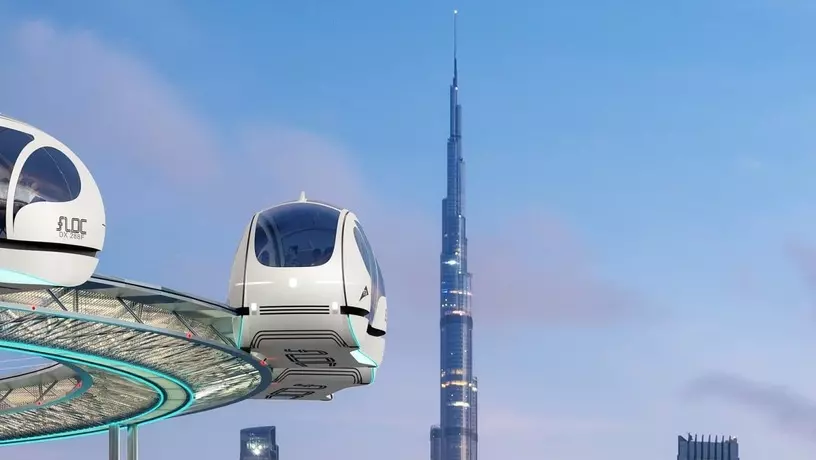
The RTA revealed plans for a futuristic pod rail system at the GITEX Global Conference in Dubai in October 2024.
The Floc Duo Rail will bring bubble-shaped self-driving electric pods to the city which will have a low carbon footprint and be cost-efficient.
Designers say that the system will be very quick to install as it requires a light infrastructure of two tracks very little steel or concrete.
Pods will match rider demand and can range in scale from small stops to large city-centre interchanges.
Larger trains can divide into shorter trains and serve the suburbs. It will be able to operate while suspended in the air and also on the ground.
The Rail Bus is another project announced at the World Governments Summit 2025. Pods will be capable of handling 40 passengers at a time and reach an operational speed of 100km/h.
Vehicles will be solar-powered, 3D-printed and optimised for urban landscapes with vehicles set to be aerodynamic to allow them to move quicker.
This one will be aimed towards enhancing first and last mile connectivity in urban areas and integrate with the existing Dubai transport network.
The seaglider promises to connect Abu Dhabi and Dubai in just half an hour at a cost of approximately Dhs165.
This would make it as quick as a helicopter and around cheaper than taking a taxi between the two largest cities in the UAE.
It’s an all-electric vehicle that combines the speed of an aircraft with the accessibility of a boat and is designed for travel between coastal cities like Dubai and Abu Dhabi.
Seagliders can float at the dock at a low speed to pick up and drop off passengers and goods before taking off out the water with the aim of avoiding waves and reducing drag.
It will then fly low over open waters at a speed of up to 180mph, within one wingspan of the water’s surface, for the majority of its journey.
Announced in 2024, the trackless tram operates on virtual tracks and offers a solution to urban transport challenges. Powered entirely by electricity, the trackless tram system is not only eco-friendly but also more cost-effective and quicker to construct than traditional tram systems.
Each tram consists of three carriages and can accommodate up to 300 passengers, making it an efficient option for city commuting.
With a top speed of 70 km/h and an operational speed ranging from 25 to 60 km/h, the tram is designed for both performance and safety. A single charge allows the tram to travel up to 100 kilometres, enhancing its viability as a sustainable public transport option.